
This is a technique to efficiently calculate the x coordinate given the x coordinate of a point on a Montgomery curve . This method is also easily implemented in a constant-time way.
This works for curves:
Satisfying .
The ladder itself
func ScalarMul(n Scalar, x Field) Field {
  nP := Projective{1, 0}
  n1P := Projective{x, 1}

  swap := 0
  for b := range n.msb .. n.lsb {
    swap ^= b
    condSwap(swap, nP, n1P)
    swap = b

    nP, n1P = step0(x, nP, n1P)
  }
  condSwap(swap, nP, n1P)
  return nP.X / nP.Z
}
Implementing the individual step:
// In field elements of course
const A24 = (A - 2) / 4

func step0(x Field, nP, n1P Projective) (Projective, Projective) {
  double_X := nP.X + nP.Z
  double_Z := nP.X - nP.Z
  // Addition
  add_X := n1P.X + n1P.Z
  add_Z := nP.X - nP.Z
  add_X *= double_Z
  add_Z *= double_X
  tmp := add_X - add_Z
  add_X += add_Z
  add_Z = tmp
  add_X.square()
  add_Z.square()
  add_Z *= x
  // Now we can do doubling
  double_X.square()
  double_Z.square()
  // Store for later
  Xn_plus_Zn_squared := double_X
  double_X *= double_Z
  tmp = Xn_plus_Zn_squared - double_Z
  double_Z = A24 * tmp
  double_Z += Xn_plus_Zn_squared
  double_Z *= tmp
  return (
    Projective{double_X, double_Z},
    Projective{add_X, add_Z}
  )
}
This could be optimized to reuse nP and n1P's buffers better as well
Given a point , the formula for is given by:
where:
(This formula is derived geometrically. is the slope of the tangent line to the curve at the point .)
Because features in the denominator, we can replace that with , and then calculate out the following identity:
This formula calculates given only , and can be shown to be valid in other edge cases. See: 1.
If we use projective coordinates, then we have . Plugging this into the formula we had above, we get:
In other terms, this means we have:
If we calculate this directly, a point doubling takes:
We can re-arrange things to allow more sharing:
If you note that:
The correctness of this formula becomes relatively clear.
This adjusted formula takes:
In can be shown that given and , we have:
(This is a monstrous PITA, see 1.)
In projective coordinates , we get:
This gives us the following formulas for addition:
Unlike with doubling, we need to have calculated prior. In practice, this constraint is easily accomodated.
This formula requires:
To simplify it, first note that because of the properties of projective coordinates, multiplying both and by gives us the same point:
A bit of toil gives us the following formula:
This gives us an improved:
In practice, we'll always have as , and as a small constant, giving us:
In practice, you have and , and calculate as well as together, giving you the following combined formula:
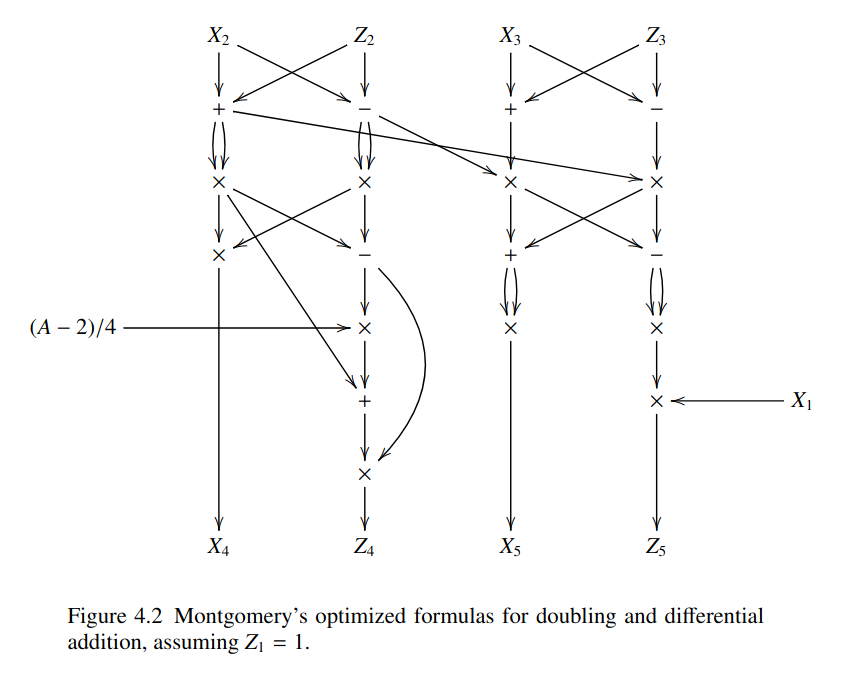
(See: 1)
One simple way to calculate is as follows. Iterate over the bits of from most to least significant. If a bit , set:
If , then set:
Our addition formula works well when we have and , and want to calculate , since the difference is , a point we already know.
At each iteration, as we rise up to , our final value, we want to keep this property, and keep the successive values around.
This, when , we do:
The first value comes from point doubling , and the second from differential point addition, using the fact that the difference is .
When , we want to do:
We can calculate the first value through point addition, and the second through point doubling.
In fact, if we define these two functions as , and respectively, we notice that comes from swapping the input, and then the output. With:
We have:
Thus, an algorithm for doing our ladder would be:
for b in bits:
  if b == 1:
    swap(P, Q)
  (P, Q) = step0(P, Q)
  if b == 1:
    swap(P, Q)
return P
We can make this "constant-time", by replacing our branching with a conditional swap:
for b in bits:
  cswap(b, P, Q)
  (P, Q) = step0(P, Q)
  cswap(b, P, Q)
return P
If we have two conditional swaps chained together
cswap(bits[i], P, Q)
cswap(bits[i - 1], P, Q)
Which happens between iterations, notice that this is effectively:
cswap(bits[i] ^ bits[i - 1], P, Q)because of this, we can effectively do:
cswap(bits[N - 1], P, Q)
step0(P, Q)
cswap(bits[N - 1] ^ bits[N - 1], P, Q)
step0(P, Q)
...
cswap(bits[1] ^ bits[0], P, Q)
step0(P, Q)
cswap(bits[0], P, Q)
Noting that 0 ^ bits[N - 1] = bits[N - 1], we can effectively do:
swap := 0
for b in bits:
  swap ^= b
  cswap(swap, P, Q)
  swap = b
  step0(P, Q)
cswap(swap, P, Q)
return P
This allows us to efficiently compute whether or not we need to swap.
This is the gist of things, see the summary up top for more useable pseudo-code.