
This note is about the discrete topology and indiscrete topology on a set .
Namely, and are functors with the following adjunctions with the forgetful functor
As a reminder, the discrete topology contains all subsets of
The indiscrete topology contains only the empty set, and all of :
[!note] Note: I like this notation, since the denotes that the discrete topology is nice and full of sets. The denotes that the indiscrete topology is empty and devoid of any sets.
It's clear that is the coarsest topology on , and is the finest topology on . Formally, for any other topology on , we have:
This is a very structural point of view, focusing on different topologies we can apply to . We can shift our view to an external point of view, focusing on what continuous maps exist on the spaces and .
The discrete space on a space can be characterized as follows. Any set function is continuous, provided is a topological space.
Since every set of is open, every pre-image of an open set is also open, so is open.
As a simple corollary, since we have , we can see that is finer than all other topologies on the same set.
Because of this property, we see that is a functor, sending a set to the discrete topological space . Set functions , are already continuous functions , because of the characterization we went over. The composition laws clearly hold, since functions are left untouched.
With this in mind, we have an even more powerful characterization:
For any set , the space is initial in the category , where is a forgetful functor .
More concretely, we have this situation:
Given any set function , where is a topological space, there exists a unique continuous map such that the following commutes:
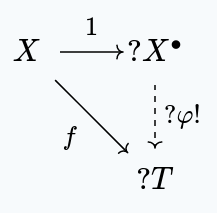
satisfies this property. For each point , we need , so we have no choice but . Since is discrete, is necessarily continuous.
is a way of creating a topological out of such that every set function out of becomes continuous.
Another property is that is terminal in the slice category :
Given any set and continuous map , there exists a unique set function such that this diagram commutes:
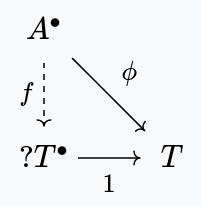
We need , so is uniquely determined as .
With these two diagrams in place, we have an adjunction:
Any function is continuous, since the only open sets are and , whose preimages are , and respectively.
is terminal in .
If is a topological space with a set function , then there exists a unique continuous map such that the following diagram commutes:
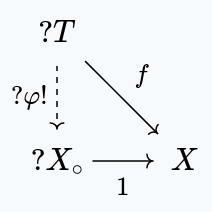
We have, once again, no choice but . This function is continuous, since any function to is continuous.
This is really just a repetition of the fact that every set function becomes a continuous map .
We have a similar dual property as before.
is initial in .
Given some set with a continuous map , there exists a unique set function making the following commute:
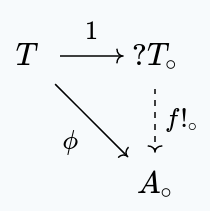
We necessarily have .
These two properties form an adjunction:
Looking at both of these in unison, we have the following adjunction:
So, is the typical left adjoint Free functor, and is a right adjoint Co-Free functor. So these two constructions are naturally dual to eachother.
allows us to make a topological space so that mapping out of the space is always continuous, and allows us to make a topological space so that mapping into the space is always continuous.
Furthermore, these defining properties are characteristic, so any space satisfying these properties must be homeomorphic.