
The usual definition of a connected space is something like:
A topological space is connected if it cannot be written as the disjoint union of open sets.
In more formal terms, if there do not exist open and nonempty, with , and , then is connected.
We call such a separation of .
A slightly more useful definition is:
A topological space is connected if and only if every continuous map to (with the discrete topology) is constant.
One way of thinking about this, is that you can only assign different colors to parts of a space (in a continuous way) if that space is disconnected.
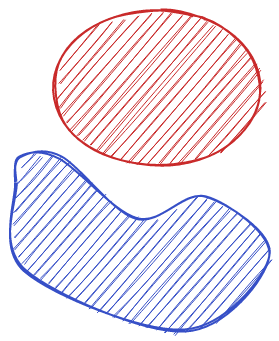
If a space is connected, then it only has a single color:

The equivalence of these two definitions is pretty easy to show:
If there exists a non constant map , then the preimages and provide us with a separation of . (These serve as the "blue" parts, and the "red" parts, going with our previous analogy).
If there is a separation of , then the map:
is continuous, and nonconstant.
Many proofs become simpler under this paradigm. For example:
Let be a collection of subspaces of , each of which is connected. If , then is connected.
Proof:
Let . Let be a point in the intersection.
Because is connected, is constant on , and equal to everywhere. is thus constant on .
This way of looking at things is quite elegant if you adopt a more categorical point of view in other parts of Topology. For example, one characterization of a quotient map is as follows:
A continuous function is a quotient map if and only if for every function that is constant on the fibers of , there exists a unique making the following diagram commute:
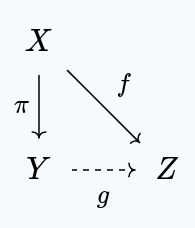
The following theorem becomes very simple with these definitions:
If is a quotient map, is connected, and furthermore, every fiber is also connected, then is connected.
Proof:
Take an arbitrary map . Because each fiber is connected, this map is constant on fibers. By the universal property of quotients, we have , for some unique . Since is connected, is constant. This means that is constant, so is connected.
(I first saw this proof, and other ideas, in "Topology: A Categorical Approach")